
Benefits of RAS
There are many more advantages of using recirculating technology in fish farming. Some are
-Removal of ammonia
-Removal of nitrites
-Remove dissolved organic solids
-Addition of oxygen
-Removes carbon dioxide
-Remove excess nitrogen and other dissolved gasses
-Remove suspended solids
-Reduced or elimination of diseases:-impact of pathogens is lowered considerably in a recirculation system as invasive diseases from the outside environment are minimized by the limited use of water.
Water for traditional fish farming is taken from a river, a lake or the sea, which naturally increases the risk of dragging in diseases.
Due to the limited use of water in recirculating the water is mainly taken from a borehole, well, drainage system or spring where the risk of diseases is minimal.
In fact, many recirculating systems do not have any problems with diseases whatsoever, and the use of medicine is therefore reduced significantly for the benefit of the production and the environment.
Lets look at the different layers of an industrial Biofiltering System:
In a recirculating system it is necessary to treat the water continuously to remove the waste products excreted by the fish, and to add oxygen to keep the fish alive and well.
A recirculation system is in fact quite simple. This is the basic principle of recirculation: From the outlet of the fish tanks the water flows to a *mechanical filter* and further on to a *biological filter* before it is *aerated and stripped of carbon dioxide* and *returned to the fish tanks*
Several other facilities can be added, such as oxygenation with pure oxygen, ultraviolet light or ozone disinfection, automatic pH regulation, heat exchanging, denitrification, etc. depending on the exact requirements.
Building RAS & Biofilter Systems:
We at DelTin ventures and Joanado farms have our own RAS setup which is relatively far cheaper but very effective than the expensive imported ones.
Items needed:
- Barrels/polytanks/IBC tank
- PVC pipes
- Tank connectors, burns, T’s
- Submersible pump
- Filter Media (nets, old cloths, curtains, quarry stones)
- Basket with holes
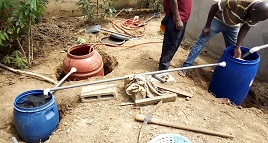
Let’s look at one type of the RAS setup at DelTin and Joanado Farms:
The First blue barrel (close the pond) is the Mechanical or Solid filter, there is a swirling effect created/generated in the barrel (solid filter) that makes all the fish pop and solid waste remain/get trapped below the barrel and clean water moves to the smaller blue drum (the biofilter) by gravity.
The biofilter (smaller blue drum) has in it basket with holes, bio filter media (bio balls, stones, sponge, pvc pipes cut into pieces, plastic bottle corks, sand, etc) which are arranged nicely as a grow medium for *beneficial bacteria* to grow and filter the water that comes in. i.e convert nitrite to natrite. Then by gravity, the cleaned water moves to the brown drum (Sump).
The sump works as a reservoir of clean water. In the Sump is the submersible pump which then lifts water back into the pond and automatically adds oxygen, expels NH3 etc.
By extension, we have added common charcoal (activated charcoal) to the sump to remove harmful gases and metals faster.
With this setup, we change water every 2months with less than 5% water top up monthly.
*For how we connect the pieces together and make it work, call 024 446 9491 or 020 828 0232*
Call us to build your RAS System so you clean less and see your fishes grow faster.